
Two great tastes that would taste great together. [sigh]
I live in Fort Worth, and there’s a particularly ugly primary challenge on the Republican side, between long-time State Representative (for district 99) Charlie Geren and up-and-comer Bo French.
I was introduced to Mr. French when he came to my door and immediately made my day by leading with how extremely liberal Charlie Geren is. I politely listened, and took his flier, thanked him, and went about my day. I didn’t disabuse him of the notion that I’m probably a conservative Republican, what with me living in an old, mostly white, relatively affluent neighborhood of Cowtown.
I don’t know if Bo put an extra star next to my name, or if he is just going nuts with the marketing, but as the primary approaches, we’ve been getting a truly obscene number of flyers: I think 4 in one day was the record. Every single one of them is doubly offensive to me: that he’s tarring his opponent mercilessly, and that the things he tarring him with are things I believe in (mostly).
The whole thing was, as I said, amusing, until I got the following postcard:
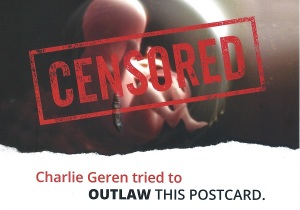

The sheer audacity of this postcard made me want to yell. I’m not going to be satisfied until I deconstruct this stupidity.
First of all, the image on the front is designed to elicit an instant, gut-level response. It’s a fetus. That means this is about abortion. (It’s not.) The used of the red faux-stamp “CENSORED” means that this terrible Charlie Geren is…I guess censoring babies? Censoring information about babies? Censoring pro-life messages? That’s it. He must be censoring pro-life messages about how it’s bad to kill babies.
You flip to the back, and now the message is clearer. This has nothing (except tangentially) to do with abortion or reproductive rights. Apparently, Geren simply wanted to make contributions to non-profits public. Okay. I guess you could make the argument that such a stance is dicey.
(I disagree, but I disagree with plenty of things that many, if not most, of the country believes. For example, apparently, most of the country believes that watching football isn’t boring. Go figure.)
But it’s how they spin it on the back of the postcard that really makes me crazy. Mr. French says these “burdensome” regulations (because listing stuff is really hard) is “intended to restrict their free speech.” No. It’s not. There’s nothing (at least as far as I can tell from this postcard) about House Bill 1533 that restricts free speech. Putting aside the fact that money isn’t speech [deep breath] these donors can speak as many dollars as they want into the coffers of the Texas Right to Life Committee. The bill says that they then have to put their mouth where their money is and say who they are.
But Mr. French (who is definitely not the kindly English butler from the 60’s TV show Family Affair) takes it another step by saying that if the bill had been made law, it would be “violating the First Amendment rights of donors” (it’s not) “and threatening their personal lives and job security.”
Okay. I suppose there may be a crazy person out there who’s trawling through donor lists of the Texas Right to Life Committee so they can track them down and shoot them. (It’s certainly easy enough to get a gun in my neighborhood. There’s a gun show a thousand yards from my daughter’s bedroom every weekend. Why am I living in this state? I digress.) But, still, I think the likelihood of donation to a cause leading to loss of life is vanishingly small.
Let’s unpack the “job security” angle. Texas is an “employment-at-will” state. Anyone can fire employees (barring contract stipulations that forbid it) for any reason, or no reason at all. (I think there are special class exceptions, but I don’t know the ins nor the outs of that.)
Does anyone here think that Mr. French is opposed to this law? Does anyone think that Mr. French would prefer that Texas not be an “employment-at-will” state? [crickets] Thought so.
But the thing about this that really gets my goat (and which is a basic thing I hadn’t really put together) is that people tend to conflate “freedom of speech” with “freedom of speech without negative consequences”. Guess what, dillhole, actions have consequences. My daughter (the one living less than grenade-launcher distance from a weekly gun show) understands that. And she’s younger than some of my shoes. If you walk up to your boss and tell him he’s a bald SOB who should be dead, he might just fire you. And you have no recourse. Your freedom of speech was preserved. As was your freedom to be a dillhole.
(Why is dillhole such a funny word? I don’t know. Back to the thread.)
Look, if you’re a donor to the Texas Right to Life Committee, or a supporter of Bo French, you should be proud of it. Don’t hide your light under a bushel! Let it shine for all to see. I don’t care. I’m actually mostly a pro-lifer. But I am emphatically an anti-illogicer. And this is some quality illogic that Mr. French is trying to use to get my neighborhood to vote for him.
Hopefully the profusion of Charlie Geren signs I see around me indicates that it’s an uphill battle.


 brenthawthorne
 David Gaw
 reviewsbyrussell
 Rip Rowan
 Cuz We Said So